Friday, 21 January 2011

28th day (Highland Playgrounds)


It's rare that we start a leg with trepidation.
We may have strayed from post-shvil Abu Negev humus of late, but that doesn't stop us having semi regular humus at Abu Rami, our "home brand" humus joint. So over humus on Sunday we discussed the upcoming leg, worrying about the very steep ascent of Mt. Carmila and then continuing for another long 18 kilomtres to the end. In the 2 years we've been shvilling we've managed to successfully dodge serious up-hills. We either deny their existence (Starting at the top of Mt Tabor rather than the bottom) or change the direction of the walk so it would be downhill rather than uphill (Mt. Meron, the Arbel). Mountains that we couldn't avoid (Mt Devorah or Mt. Yona, both on the same day!) caused us a masochistic mix of enjoyment, suffering and exhaustion. When I got into Yoni's car at 5.30 (that's right, in the morning.) and expressed that my fears of tackling the climb had occupied my thoughts all week, he echoed the same doubts. When we met up with Garry and Tracey, they too said that it had been on their minds.  Even Garry, bruised and sore from falling off the roof of his house, didn't exactly exude his normal easy going mindset. I refused however to entertain the possibility of starting at the top, even though there is a road that would have taken us there. The only concession we made for ourselves was parking at Neveh Shalom rather than the Latrun monastery, saving about a kilometre and a half at the end.
We welcomed two new guest-shvillers with us today. Mark was getting a Friday off from the Boss to join us and Rinat was making good a long held threat of doing a leg with us. The 5 of us finished high school together 34 years ago. The guests didn't get the courtesy of a warning in regards to Mt. Carmilla, for fear of them chickening out. What you don't know can't hurt you.

So there we were, in the car-park of the Bnei Brit Cave, looking up at the hill we were about to climb. At least it was early, the weather cool and the trail passed through forest. We couldn't start up the path though until we'd had a look at the cave. The road leading to the cave runs through what is called the Martyr's Forest. World Bnei Brit has planted six million trees in the forest in memory of the six million Jews murdered during the holocaust. Along the way we saw plaques embedded into the rocks that bordered the road, commemorating specific victims. The cave is a place where members of the Bnei Brit world organisation come to remember those victims. As would be expected, the area around the cave is neat, well tended and quiet, modestly set in a valley surrounded by the Jerusalem Hills and forest. The cave itself is, well, a cave. Just three chambers, two entrances and it
self as modest as the surroundings outside. The area doesn't resemble the large grandiose spectacles that we might sometimes expect from Diaspora Jewish organisations.


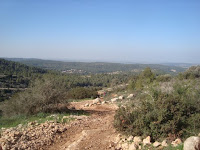
Lingering in the environs of the cave a few moments more, in order to stall the beginning of our clambering up the mountain, we eventually made our way to the trail head. After a hundred metres we stopped to make sure we were on the right path. We were climbing alright, but so gently that we didn't believe that this was the mountain that had us pleading to our cardiologists to forbid us from attempting the climb during the week. Gradually, however, the sweaters came off, pulse rates went from 90 to 120 to 150 a minute and the sweat started to build. Water stops allowed us to catch our breaths and awe at the breathtaking views. By the time we came out of the forest path onto a dirt track, which marked the end of the steepest part of the climb, we felt we'd had a good workout. But no more than that. No crawling up ravines, no clinging to vertical rock faces, no swearing that this was the last time we'd ever attempt such a foolhardy endeavour. Simply a good workout. Perhaps it was the cool of the morning, or tackling the climb at the beginning of the day. Maybe it didn't seem so hard because we were distracted by the magnificent clear views, starting beneath the mountains and gradually climbed up to the height of the surrounding hills and then above, or perhaps the refreshing conversation of friends not seen for many years or a few days. Whatever the reason, the climb was fantastic. We sat down, drank some more water, exchanged pleasantries with the first batch of many mountain-bike riders that we saw, and continued on our merry way. It's strange how the numerous bike riders we see treat us with a mix of contempt and confusion, not quite understanding how anyone would want to be in the great outdoors on foot rather than on bicycle. We can't quite understand why someone would want to work so hard as to pedal when walking is so much slower and more pleasant. And never the twain shall meet.

The bicycle path continued on a gradual upward incline, which after what we'd just done was barely felt.

Soon we came to a bitumen road (the one we could have taken if we'd decided to dodge the ascent) leading to the chicken sheds of some moshav and then onwards to some other moshav. A tour bus was parked on the other side of the road but no tourists were to be seen. Crossing the road, we continued along the marked shvil track. A couple of hundred metres on we found the tourists from the said tour bus in a clearing. The clearing was next to some picnic tables that just beckoned to have 6 cups, Garry's herbal tea, chocolate croissants, Sigal's (Yoni's wife) banana cake, Rinat's cheese cake and Mark's halva bars placed down on it. Have I mentioned before that we're never hungry? This is getting ridiculous. And tasty. So whilst we sipped our tea and replaced double the calories that we'd spent going up the hill, we heard the tour guide explain about the importance of this area in the war of independence and the importance of remembering and respecting those that gave their lives so the state could be born. We were now on the Burma Road, the route that was used to reach Jerusalem during the War of Independence, since the primary route through the Jerusalem Corridor was controlled by the Arabs. I'm not an historian but I think it's agreed that Israel wouldn't have been able to hold West Jerusalem had we not had this avenue to the city. The remainder of today's walk was along the Burma Road


The Burma Road is not only an important area in the history of the fledgling State of Israel, It is situated in the Jerusalem Hills, the closest set of mountains to the 4 million people that live in the centre of the country. The combination of these two facts ensures that many people visit this area annually and it is thus well maintained.  The entire area is managed by the Keren Kayemet, with signs explaining the historical significance of each point, folksy cut-out sculptures to help the simple-minded understand the significance of the area and lots and lots of picnic tables. We saw more picnic tables today than what we'd seen in total these past two years on the shvil. A real highland playground. And very well done, at that. If we'd adopted our usual habit of sitting and drinking, eating or resting at every pretty, tabled picnic spot, we'd still be on the trail now and our spouses would have had to send out search parties to find us. Oh dear.

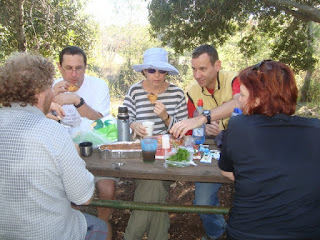
So there we were, sitting down at the first of the thousands of picnic tables we would pass today, half listening to the guide, half trying to have a whispered conversation so as not to disturb the guide and his group that was here before us. Eventually the guide ushered the group back to the bus and we could have a normal conversation. As we got up to leave, we passed the clearing where the guide had been instilling Zionist values into his flock. It's a pity that his Zionist values didn't include keeping his beloved country clean. The mess his group left was a shameful example of how the ugly Israeli might like to experience nature but won't see the importance of keeping that same nature clean. Perhaps because this area is so heavily touristed and the Keren Kayemet has put so much effort into the trail, there are workers whose job it is to keep the parks clean. Other than the litter here, we saw very little of the strewn rubbish that we've seen in other places on the shvil. It could well be that by the end of the day the cleaning crew had come through and cleaned up after the Zionist guide and his disciples. We'll never know


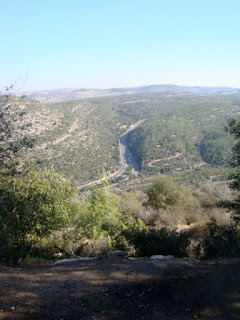
Soon we came upon mishlat (command-point) no.16. Dotted along this road are a number of command points. The views from these points over the valley below and the road up to Jerusalem were stunning. Quite obviously, if you controlled these command points you could control this road and possibly the road beneath as well. Each lookout and command point had an explanation of its part in the War of Independence. And a picnic table or two. In all seriousness, it's very well set out and gives an interesting history lesson about the days around the War of Independence amid the beautiful alpine setting. After a number of these mountain-top lookouts the path started its descent to lower territory. The going was slow not because of the difficulty of the path but because of the constant stream of off-road vehicles climbing a track that is definitely not meant for vehicular traffic. If that wasn't bad enough, each car had a single occupant, a male driver. To us it seemed that it would be far more fun, social and fuel efficient if there'd been three or four people to each car, but then again, I guess we didn't feel the need to prove our masculinity by driving individually along a path meant for walking. Each to their own.


As is the case with historical, war related areas, we passed a number of memorials, each nicely set out with its obligatory picnic-table-in-the-shade, beckoning us like silent sprukers to come and rest weary limbs on its wooden bench. At the bottom of the mountain we found a particularly large and charming memorial to the Machal (Mitnadvei Chutz L'aretz, or overseas volunteers). This was one we couldn't let go, so we planted bums on benches and out came the myriad sandwiches. The six of us couldn't finish all we'd brought. Onwards out of this park, we crossed the road leading to Beit Shemesh and marched through another park. The Burma Road is just a string of interconnected picnic tables placed in pretty places. From here on in for the next seven kilomtres we had a hill or two, lots of forests, lots of commemorative plaques and lots of picnic spots. And we weren't bored for a second. Eventually we got to Neveh Shalom, the mixed Jewish and Arab village that hopes to show that we can actually live together, regretting parking the car there. We were having so much fun that we could have easily walked through the fields to the Latrun monastery.

Once again, no humus. We were too full. After a quick double macchiato at the local Segafreddo we all went our separate ways, with the hope that Mark and Rinat can do a guest appearance next time as well.
Friday, 24 December 2010

27th day (Overnight Done Right)


I awoke bright and early the next morning, refreshed after a good night's sleep. Yoni and Garry didn't get up nearly as energetically, ascertaining that my snoring kept them awake all night. They even went as far as claiming that the aural resonance was so deafening that the air-force scrambled fighter planes, thinking that our friends in Gazza were testing a new type of missile. Garry tried to record my snoring using the microphone on his cell-phone but upon play-back all I heard was the sweet sounds of contented sleep. As far as I'm concerned, I suspect a conspiracy…their claims are identical to those Susan has been complaining about these last twenty something years. In any case, I heard mumbled threats of locking me in a sound-proof cell next time we do an overnight.

Snoring or not, it's amazing what a good cup of coffee and a brie, avocado and prosciutto sandwich can do to shake off the cobwebs. After preparing rolls for the day's walk, by 7.30 we'd loaded the cars and bade farewell to the Galon guesthouse. Upon consultation with the book it was decided we would park at Moshav Achuzam and thus save ourselves a kilomtre's walk along the road. Yoni was especially happy with Achuzam, as it fitted very nicely into his Negev-retro theory. Here was a moshav that hasn't changed since the 60's. In fact, I think most of the houses hadn't been painted since the 60's. Many moshavim today have a new community neighbourhood built within the settlement. These community neighbourhoods offer relatively cheap land and building to people who want to live in a country environment but still desire all the advantages of middle-class living. Yoni and I both live in community settlements. Time-warped Achuzam doesn't seem to have heard of this very common trend. This old-style moshav looks a bit run-down, with chickens houses or small dairies adjacent to their unkempt properties. The roads are pot-holed and the cars either dilapidated bombs or modern, expensive, status-mobiles. Not many standard Hyundies here. It appeared as if modernity had skipped past this corner of the Negev.
Unfortunately the trail markings at Achuzam were no-where to be found. According to the second book, the shvil takes an entirely different route, some 3 km to the south. We've noticed minor discrepancies between the two books but never to this degree. Eventually we found shvil markings that had been painted over. The route had obviously changed and no-one bothered to inform the poor old bugger who wrote the first book. Once we realized that the updated route avoided road walking (a wise update, indeed) then we parked at Tel Keshet and drove to the starting point at Lachish, where we'd finished the day before. By 8.30, a little later than planned, we were on the track. With only 14 easy kilometres to do, the later-than-planned start was not critical.
It wasn't surprising that the first part of the walk was the same as the previous day's; vineyards. Occasionally we walked between the rows and found bunches of grapes still on the vine that hadn't been picked. Left on the vine they dry out slowly and become raisins. Intensely sweet, moist and natural we gobbled them straight off the vine and they were delicious.

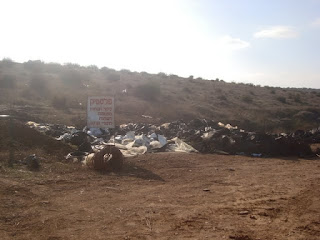
Not far from the start we walked past what looked like an agricultural equipment dumping ground, full of used irrigation piping, large plastic sheets and some old abandonned tires. Next to it was a small sign in Hebrew and next to that a large sign in Thai. Obviously it's the Thai workers, who do nearly all the agricultural work in Israel today, that needed the  instruction regarding the dump. I don't know if this mess was indeed a dump or a sort of recycling depot. Perhaps if they needed to lay pipes or use a large black plastic sheet  they would take it from here rather than use costly new equipment. My Thai isn't good enough to understand the sign so I can't be certain what this place was meant to be used for.


We did spot, however, an interesting piece of recycling. In an area of small, newly planted vines, the tender trunks were protected by Tnuva 1-litre milk cartons. Quite a weird sight, walking past a young vineyard with row after row of milk cartons on the ground around thin tree-trunks. Maybe it’s a new hybrid, milk flavored grape variety, or a ready grown grape milkshake.


From memory (in my case an unreliable piece of equipment), we saw our first ultra-light in the almost two years of shvilling, buzzing overhead like an overgrown mosquito. The pilot did a couple of passes over us, once flying low enough to wave at us. Unfortunately the slow shutter response of my camera and slow neuron response of my brain, prevented me from successfully taking a photo, but you'll have to believe me on this one. Garry and I thought flying in an ultra-light over the region would be a great experience. Yoni, still traumatized by jumping out of a plane with just a parachute on his back during his army service, is only willing to leave the ground these days protected by at least 20 tons of metal and powered by a minimum of 2, preferably 4, jet engines.


Not for the first time on the shvil, we saw horses and riders gallop past. Usually we see them in small groups of 3 or 4. Today it was a full posse, at least twenty in number. There were no bad guys in this posse, however. Each rider politely waved us a cheery hello as he rode past on his trusty steed. Very civilised.


Gradually the scenery changed from vineyards to wheat fields. The wheat fields this time of year are very attractive, especially when they totally surround you. We've only had one serious bout of rain this season so the wheat has only just sprouted. The deep brown colored earth is still visible under the green of the wheat sprouts and with the soft winter light it's a very pleasant walking environment… especially if you're walking through gentle, undulating hills that cause barely a drop of sweat. If we did start to sweat, there's no shortage of trees sprinkled along the path to rest under. And if a single tree is not enough, then there are a few small eucalyptus groves of about twenty trees along the way. Very considerate.


Eventually the fields gave way to uninteresting bare terrain, but so far over these 2 days we'd walked 16 pleasant kilometres, so a bit of boredom is nothing to complain about. As if to further remind us that Shvil Yisrael is not all pretty rural scenery, Mr. shvil painter has us walk towards, beside and eventually under kvish 6. Just when we thought we'd seen the last of it, up it pops. And it's just as much an eye-sore in the Negev as in the centre of the country. (Unless I'm driving on it. Then it's a god-send.)


As we were about to cross under kvish 6 we walked passed a single concrete block in the middle of the path with the familiar shvil sign painted on it. The block had no obvious purpose other than to be there so Mr shvil painter could put a sign on it. How and why Mr shvil painter convinced the Shvil Elders to drop this concrete obelisk in the middle of no-where is a mystery to me. Of the series of books I am planning to publish when we finish the shvil, sometime around the turn of the next decade, this anomily  will certainly appear in the volume titled "Mysteries of the Shvil", alongside "The Shvil on a Full Stomach" and "The Driver's Guide to the Shvil". Does anyone know a brave (foolhardy?) publisher?


We'd left the agriculture behind and were now walking above the banks of nachal (creek) Adura'im. It's a dry creek that only runs when it rains, where flash floods run through the creeks in the Negev and the water disappears as quickly as it appears. Thorny acacia trees dot the banks of the creek. We found ourselves one particularly large and shady one to rest under. We sat down on a bed of small drying orange acacia berries and finished off our lunch sandwiches. Ah…this is the life! Thirty minutes later we were back at Garry's car, having completed the easiest 14, or 22 km including the previous day, that you can imagine.


Getting back to Yoni's car entailed making quite a large loop along the no. 40 road and then kvish 6. Boring. We thought that if we drove along a few dirt tracks we'd find a short cut, make the drive more interesting and save about 15 minutes driving. We were driving in Garry's Mazda 3 which, with three grown adults inside, sits about 10 cm off the road. When the "road" is a track that resembles an obstacle course, with myriad obstructions 11 cm or higher, well, need I continue? At one point I got out of the car and cleared rocks from the path (I wouldn't even call it a track) so the car could pass. In the beginning the dirt track was quite reasonable but as we continued "reasonable" changed to poor which changed to terrible. And suddenly there was no track at all. Just a field, a shiny blue Mazda 3 and Yoni and I walking in front or behind, trying to help Garry navigate through. Seinfeld, anyone? Eventually we got to an unsealed road that seemed like an autobahn after what the car had been through. This road came to the main road that we'd wanted to get to in the first place. After 45 minutes of Leyland Brothers impersonation (the Australians will understand) we arrived to the point that allowed us to save 15 minutes.

That was the last of the adventures, unless stopping off for ice cream along the much shvil-maligned kvish 6 counts.

All in, I can safely say that we implemented the lessons from our first overnight trip; This time we had an easy first day, we prepared food and water for the next day, we weren't out till too late, we got a decent night's sleep (or at least I did) and we picked a really nice route that suited us. There's no doubt that the decision to jump forward was the right one. We'll do a few more Negev walks before going back to the area around Jerusalem. We're really looking forward to them.
Outdoors Blogs
Outdoors blogs