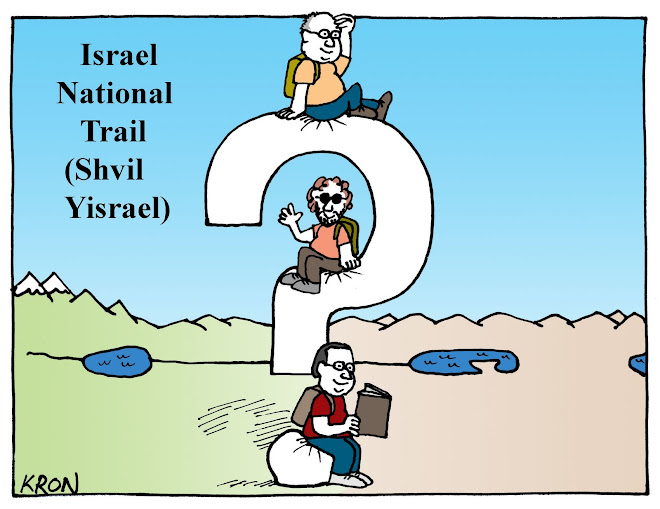


There are a number of ways I could start this chapter.
I can start by explaining how over the next two days we were going to implement lessons learnt from our previous overnight leg. I can start by saying how we were simultaneously excited and filled with trepidation about starting a two day, overnight leg. I can start by explaining why we were at Beit Govrin, about 60 shvil km from where we finished last time. Or I can start by announcing that I was taking my brand new hiking pole for a test run.
Instead I'll just start by saying that at one thirty on a glorious Thursday afternoon we found ourselves walking down a bitumen road, something that we have fastidiously avoided these past 2 years, because the maps in both of the not all together reliable guide books that we use had us believe that the beginning of today's leg was opposite the petrol station where we'd parked and not 300 metres down the road. Hmpf. Not to worry. That was about the worst experience we had over the next 24 hours. Can't complain about that.


We turned off the road onto a track that led us through some fields. We immediately forgot that we'd just broken, through no fault of our own, one of our cardinal shvil rules. It was good to get back to some good old fashioned shvil walking that was similar to the first year's tracks. We were back in the country, away from the "almost" country, with construction and highways around the next bend, as in the last few legs. It might be the outback, but it is very different from the terrain of those first walks through the Galil. Takes a genius to see that, doesn't it? It was also exciting to walk through an area that we had never been through. (Sort of…Yoni and Garry did recount stories of their army days in this area in the middle of the previous century).


The first landmark we came to was a large, lone building called "The Villa". It was owned by a wealthy Palestinian from Hebron, who in the 1940's sold land to the Keren Kayemet. He was found dead inside the house in 1946. Well there's a surprise.

In the beginning the landscape consisted of open brown fields or scrubby, rocky, semi desert with an occasional large tree, planted by nature 50 years ago, solely in order to give us shade to rest under during one of our drink stops. The terrain was perfect for walking, as was the 22 degree dry winter weather. Here in the Negev the expanses are much bigger than in our cramped Galil, not to mention the claustrophobic centre of the country. Rolling hills roll as far as the horizon. If the path led through a just sprouted wheat field, it surrounded us in all directions. It may not be Texas or the Great Outback, but compared to what we're used to it was definitely big.
On one of our drink stops a question was put to the quorum: Who, in your opinion, do you prefer…Microsoft, Apple or Google? The answer led to a very interesting discussion about marketing, branding, perception and image. Such is the wide nature of our discussions; sometimes totally inane, sometimes nostalgic and sometimes challenging. Comments on the subject are most welcome.


This region is known for grape growing. "Invei Tali" (Tali grapes) which are Israel's most widely sold and sweetest table grapes are grown around Moshav Lachish, the area we were walking towards today. Very good quality wine grapes are also grown here. The warm winter has left the vines with their leaves still attached. Each variety of grape seems to have a different colour of autumn foliage. Wandering through the vineyards was like walking in the middle of a giant patchwork quilt, each section a different colour and us, tiny ants walking up the seams. The New Englanders amongst us who may be reading this might roll their eyes and let out a bored, patronising yawn. After all, it isn't Vermont in September, but for us, in the sometime monochrome Israeli countryside, it was pretty special.


The range of colours of the different varieties of grape vine was enhanced by the light. It's very difficult to describe, but the afternoon winter light is much softer than harsh, glary summer light. The browns of the soil, the grey of the rocks, the different shades of green of the trees, wheat and grape vines look so different under these conditions. We're so used to the harsh Israeli sun-light that you really notice it when you see some of this softer, more pleasant light. I, at least, can't remember seeing light and colours like this in Israel.


After a couple of hours of mixing wheat fields, vineyards and semi-desert we got to Garry's car. A lovely short stroll that would leave us refreshed for the longer part of the leg tomorrow.
The walking had finished, but our day certainly hadn't.


We'd booked a room ("a"=singular) at the country accommodation at kibbutz Galon, about 15 minutes away from Lachish, where we finished. Country is about right, or rustic for one of a better word. We're not fussy, which is just as well, as the room had 4 beds, a television, a kettle and a bathroom. It was clean and was all we needed. Some cups, basic crockery and cutlery would have been nice, but I'm not complaining… well, not very much, at least. We didn't work up much of a sweat but there was plenty of hot water anyway, so we could make ourselves beautiful for the upcoming dinner with our daughters. But more of that later.
We wanted to buy supplies for breakfast and sandwiches for the next day but the general store at Galon proved to be as spartan as the guest-room. Strange, within Galon there was an array of food options. A gourmet (so they claim) African restaurant, a pizza joint and even fish and chips. It's as if they're saying "don't bother trying to find anything to buy in the general store, eat out instead".
Luckily, a couple of kilometres away at the neighbouring kibbutz, Beit Nir, the general store was far better equipped. One of the lessons we'd learnt from our only previous sleep-over was to ensure that we didn't walk on an empty stomach or let it empty en-route. We stocked up on basic items such as Brie, prosciutto, fine hard cheese, hot pepper salad and whole-wheat rolls. Oh, yeah, some non-essentials as well, such as tomatoes, cottage cheese, milk, coffee, and avocado. We weren't going to starve tomorrow.
Beit Nir itself is as well kept as its general store. Yoni has a theory that large swathes of the Negev exist in a time warp, left that way to show the world that the "old" Israel of the 60's still exists, the Israel that the Jewish Agency made films about to send to the diaspora. Beit Nir has perfectly kept lawns, families (women, actually) pushing their babies around in the old square baby buggies whilst the men toil, pulling irrigation pipes through the field. The dining hall is still the centre of the community and next to it stands the old water tower, empty and useless but still part of that classic scene. There aren't many kibbutzim left today that still have that idyllic picture but Beit Nir is one of them.
Back to our slightly run down Galon to rest, shower and get ready for the evening ahead which entailed picking my Sivan up from Eshel HaNassi where she's doing a year of voluntary work and Yoni's daughter Lior from the army base where she is serving in the armed forces, just outside Be'er Sheva. We were taking them for dinner in a fine Be'er Sheva tapas bar. I don't know who were more excited, Yoni and I for taking our daughters out or our daughters at being taken out by their fathers.
I have always had a rather negative opinion of Be'er Sheva, without knowing it, of course. I imagined it as a parochial country town full of crime and hard living, in keeping with the 60's time warp Negev. Naturally, Tuval, Kedarim and Manof are so perfectly cool and centre-of-the universe, allowing me to look down my nose at the capital of the Negev with disdain. I can't claim to know Be'er Sheva much better after one meal but I will say that the Smilensky Tapas Bar is a cool place that wouldn't be out of place in downtown Tel Aviv, if not Barcelona. Tapas and vino beats Abu Abu humus, that's for sure. Even better with our grown-up daughters.


Yoni's journey back to Lior's base and then back to our abode was considerably longer than Galon via Sivan's place and in a totally different direction, so I decided to go with him in order to keep him company. Garry would take Sivan back without me. Trouble is we don't know the area too well (at all) and Garry is not great at following instructions. Just ask Kim. It took many minutes of patient (or confusing) instruction and eventual writing the directions on a napkin in order for Garry to feel that he could make his way back to our lodgings. Garry was asleep already by the time Yoni and I got back to Galon, so I guess that means that his paper napkin got him back ok. Naively we had hoped to be in bed by ten, applying another lesson from our previous Tel Aviv overnight. We were, however, still in the restaurant at ten, but by midnight I was happily snoring in our little room.

As we settled into our soft mattresses, I couldn't help but feel as if we were 15 years old again, at an overnight Habonim youth movement camp. That's not a bad feeling when your 50 years old.


