Monday, 22 February 2010

13th Day (Just Shvil)


A small announcement. We've been on the shvil now for a year. We started at Dan on a beautiful late winter's day mid February 2009 and here we are, a year on, parking the car at the edge of the gush alonim (No, not gush emunim, that's altogether different and not part of the route) forest.

As usual, we didn't really agree about where to park. There was a perfectly good spot at the entrance to the forest but democracy being what it is we drove an extra kilometre along a dirt track because some of my fellow walkers think "why walk when you can drive"? This democracy thing is getting to be even less in my favour now that Tracey is a regular guest. Speaking of the walking\driving debate, this is 1 of 2 constants that we have adhered to in the year on the trail.

1-      Avoid walking on road. With one exception (day three which had us do a long road walk  with a net uphill gradient) we drive to the point where the road ends and the path starts.
2-      Why walk uphill when you can do the same route downhill?  With one exception (day three which had us do a long road walk with a net  uphill gradient) we've changed the direction of the walk depending on the hills and will continue to do so in the future.
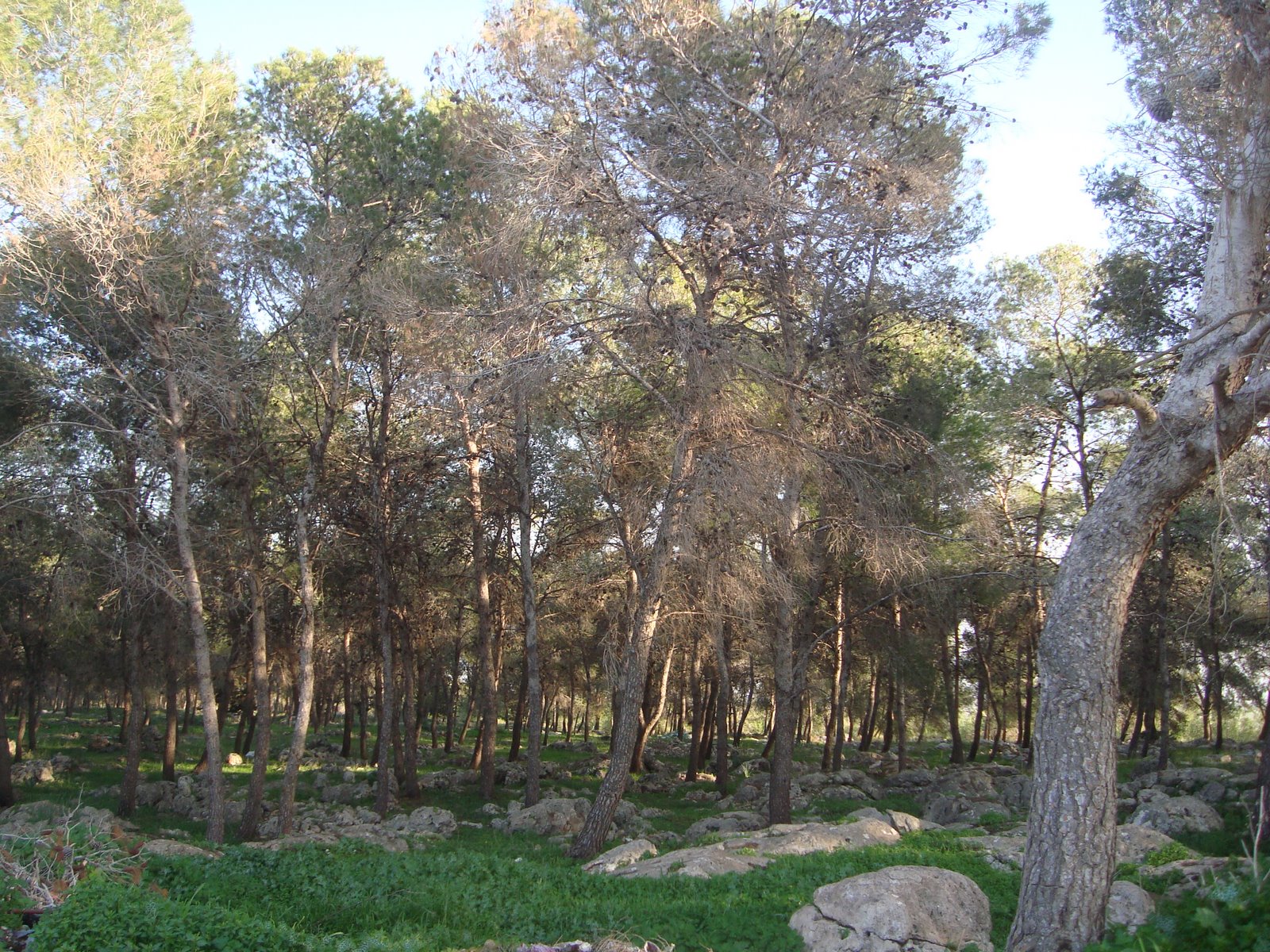
As we got out of the car and started walking we immediately saw what we'd expected to see today. Wildflowers, wildflowers and more wildflowers. Mostly white and pink rakafot (cyclamen) and red kalaniot (anemone). Here and there the cedar and oak forest was dotted with yellow wild mustard and white wild garlic. I wouldn't claim that we're knowledgeable in the field of botany nor are we especially flower-mad like many Israelis this time of year, but you just couldn't remain indifferent to the sight. So we found ourselves walking through this for the first part of the leg. Not a bad start.

We continued through the forest for a while, came out of the forest, walked past small fields of wheat or olive groves and got to the Bedouin village of Ka'abyah, which was indistinguishable from other villages we've been through. Up some hills, down some hills, a bit of puffing and panting but this too was indistinguishable from the puffing and panting we've done in previous walks. Actually today's walk was not that dissimilar to the previous walk, which is no surprise since it's the same geographical region of the country. 
Once we came out of the gush alonim forest most of the walk was in the open. And in this open area we had close view of one settlement or another the whole time. More Arab villages and more Jewish kibbutzim or community settlements than in the deep north. The Jewish settlements of Harduf or Nofit, Arab villages of Ka'abyah, Tabash or Hajajarah. The first few walks went through areas that were sparsely populated but we've noticed that as we get further south there is more evidence of human activity.
 Eventually we got to the Yavke spring (Not convinced that my transliteration is entirely accurate) which was more or less the halfway point. It's a pretty little spring, a Byzantine concrete rectangle, full of water that looks clean enough but given the amount of cattle and Bedouin villages that aren't connected to a proper sewerage system in the area, I was glad that the weather wasn't hot enough to tempt us to have a dip.

Today's leg was differentiated from previous ones by the fact that is was almost entirely marked  with just the white, blue and orange Shvil Yisrael markings. Most of the paths that we've walked on have a regular red\white, blue\white or black\white marking and thus the route of the shvil overlaps an existing trail. Here and there we had trails that were exclusive to the Shvil Yisrael route.
These exclusive shvil trails would link or cross between existing trails. Today, however, almost the entire route was just a Shvil Yisrael route.That means that Mr.shvil painter had to be on his best behaviour. He couldn't rely on the fact that if he was a bit slack with his markings it didn't matter too much because the trail was going to be  marked anyway with another colour marking. By and large he earned his wage today, but he wasn't perfect. Barely 30 metres would pass before we'd worriedly start to look for the next marking and there were a few times when we had to backtrack a little or stop until we found the way. This was compounded by the fact that today's route had quite a few sections where there simply wasn't a path. There were stretches where every 50 metres or so there would be a marking on a tree, rock or post and we'd advance that way. It was actually quite a lot of fun, mostly. It seemed that we took it in turns finding the markings, with the exception of Yoni who must have left his glasses at home since he consistently missed them. There was one point, however, where he saved us from getting what could have been quite lost had he not spotted the sign that had us leave what appeared to be the logical route and take a sudden and unexpected left hand turn. Tracey was our chief sign-spotter today, but this made amends for last time when at the start she waited for us at the entrance to Mashad, ringing us saying that she couldn't find the shvil marking painted on a street sign in the entrance to the village. When we got there she was sitting beneath the very sign that she couldn't find.
After leaving the spring we followed  Nachal Tzippori, knowing that this wasn't the exact route that the shvil planners would have us follow. We knew that the true path was a little higher and it would eventually drop down to the valley so there was not really any chance of getting lost.
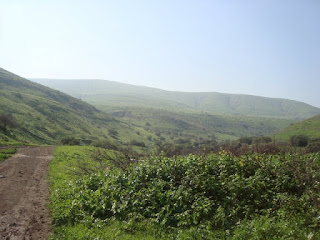
It really was very pretty. Not the majestic awe inspiring beauty of the Himalayas, Rockys or Andes. Not even the magnificent views from our own hill, Mt Meron. But you don't always need that knock-out, take-your-breath-away beauty. This small, shallow, green valley, with a swift flowing creek running down the middle, on a warm winter's day, was not taken for granted. Appreciating this idyll is exclusively for the winter and spring however. In summer this would be a dry, brown, open, hazy, dustbowl and if I'd been walking it I doubt if I would wax so lyrical.

After a while we got to an old stone building called the nun's mill.  Obviously in the past it was a water powered mill that was run by nuns. It is still owned by the Vatican and this mill in the valley was the closest thing to Tuscany outside of Tuscany that you could imagine.
Today it is let to private holders who run it as a function hall. Here in the middle of no-where. A more perfect, picturesque setting for a function would be hard to find.
For us the Nachal Tzippori valley was a discovery, but for most of the other 7 million people living in Israel it apparently wasn't. Or so it seemed. This portion of the walk seemed to be the Dizengof of the lower galilee. Other walkers (not shvillers), day-trippers, 4*4s, 2*4s,
motorbikes, bicycles, motorized ATV buggies.Gary correctly spotted the Jewish bike riders as opposed to the Arab ones by the helmets on their little Jewish heads.
 We've gotten used to walking in nature with just ourselves for company. Occasionally we cross another walker and exchange pleasantries and small talk. Here we were forced to share our nature with LOTS  of other people and we weren't real happy about it, snobs that we are. In particular there was this one old fella out on a stroll. Being the power walkers that we are we overtook him. As we passed him we exchanged the usual pleasantries. He seemed to take this as a sign that we wanted to engage in conversation, which we didn't. So at first we were 10 metres in front of him and he tried to talk to us about his family. As we got 20 metres in front of him he continued talking to us about the state of the nation. We were 30 metres ahead of him and it was his wife. We were now 40 metres in front of him and he had to raise his voice a little so we could hear him talk about the weather. As the gap stretched out to 50 metres we could still vaguely hear him but I can't tell you  what he was saying or to whom.This was mildly amusing, especially compared to this Israeli women who was sitting by the banks of the creek while we were sitting under a tree having Garry's herbal tea and our shvil sandwiches. She must have overhead us speaking in English so she decided to start up a conversation in English. As I have already stated, we are snobs, or at least like our nature to ourselves. Small talk here and there, well, ok if we must, but not with obnoxious Israelis that want to show off their pigeon English or patronise us because they think we can't speak Hebrew, even if we answer in fluent Hebrew.


After a few kilometres the path took us off the busy track and into the bush. At first there was no path at all, just signs painted on whatever the shvil painter could find to paint on. Eventually it did turn into a path of sorts and this continued on for a bit, up a slight incline in a small valley under the settlement of Nofit. As we walked further up the valley the path became less distinct and the signs harder to spot until we found ourselves walking through a field of prickles. It was very pretty and very weird. Pretty because we were surrounded by bright green with lots of high yellow flowers. Weird because this green was high prickly weeds which we couldn't avoid. There was no path, or at least the path was so overgrown by winter growth that it was as good as non-existent. And you can forget about shvil markings.

On the assumption that they did exist they too were were hidden by these prickly weeds. It was a bit disconcerting. We didn't feel lost and indeed we weren't, the valley being the obvious route, but the fact was that we  felt a little insecure about not having the re-assuring shvil signs every 50 metres. This was compounded by the unexpected heat, our fatigue and the knowledge that we were getting close to the end but didn't know how close. Still, eventually the weeds gave way to meadows and a path. And to the sound of cars travelling on a road not far up ahead.
Whilst we were crossing the final meadow before we got to the car we walked passed a scene worthy of a Monet painting. A young couple with a child sitting in the sun surrounded by red and yellow spring flowers.
I almost looked around trying to spy the French Impressionist with the beret on his head and easel and paints in tow .We also saw the first shvillers  for quite a number of walks. They had all the tell-tale signs of shvillers. A three-some (why shvillers always walk in groups of three is, in my opinion,a study worthy of funding by one of our universities). At least one of the three-some with dreadlocks. Rucksacks at least equal to the weight of the girl in the group. These shvillers however lacked one important feature of most other shvillers we'd met. The serious "we're on a mission" attitude that shvillers always seem to have (In truth, 960 km in 3 months is a real mission). These shvillers were happily lounging in the sun at 11 o'clock in the morning, resting on their rucksacks as if the day's walk was over. Given the perfect conditions I certainly couldn't blame them.

Lunch today was well earned. If your local, generic Arab hummus joint we call Abu Abu, then Samir Amis in the outskirts if Tivon  we might call Abu Jew. An Arab restaurant that seems sanitised enough so you average Jew won't feel threatened and whose principal client base is indeed the Jewish population in the surrounding area. An Arab restaurant for the Jews. The mix between the Jewish clientele and Arab cuisine has even led them to some strange dishes, like majadara made of quinoa and lentils. Still, we were so hot, hungry and thirsty that we finished it off along with everything else they placed in front of us.
And in the end, a surprise. It had to happen eventually. This is after all shvil YISRAEL, i.e. Israel. We always park a car at the beginning and at the end, often in the middle of no-where. In Israel, if you leave a car in a secluded spot often or long enough it will at some point get broken into. So I'm philosophical about my van being broken into. No damage, just the radio-disk stolen and I put it down as part of the shvil yisrael experience.

Friday, 29 January 2010

12th day (Unfinished Business)

In October we did a long, hard, hot and thirsty leg that finished just outside the township of Yavniel. (See 9th leg to refresh the memory). It may have been long, but the entire length of that particular leg was even longer, about 27 km. Too long for us in one day. So we decided that a short easy leg, about 9 downhill kilometres, that would complete the three quarters of the leg that we'd already done,  was just what we wanted for today. In retrospect, I wouldn't describe it as an arduous trek, but it wasn't quite the hop, skip and a jump that we thought that we'd be doing. I'm not going to embarrass myself by implying that it was a hard walk if Yoni's 9 year old daughter, Yael, walked the walk without as much as a whimper. No, no,no, a nine year old, no matter how tough she is, is not going to tough me out. I will say, however, that I really enjoyed having our guest 9 year old walker with us today.
What did make today's walk harder than what it may ordinarily have been was the week's torrential rain which added water to places where there isn't usually water and mud that was heavy, thick, gooey and slippery. Especially slippery. Each one of the four of us, on at least one occasion, found himself on his bum when a split second earlier his legs had been attached to the ground. Even the usually nimble Garry took a fall or two. I think Yael was probably the sturdiest of us all.
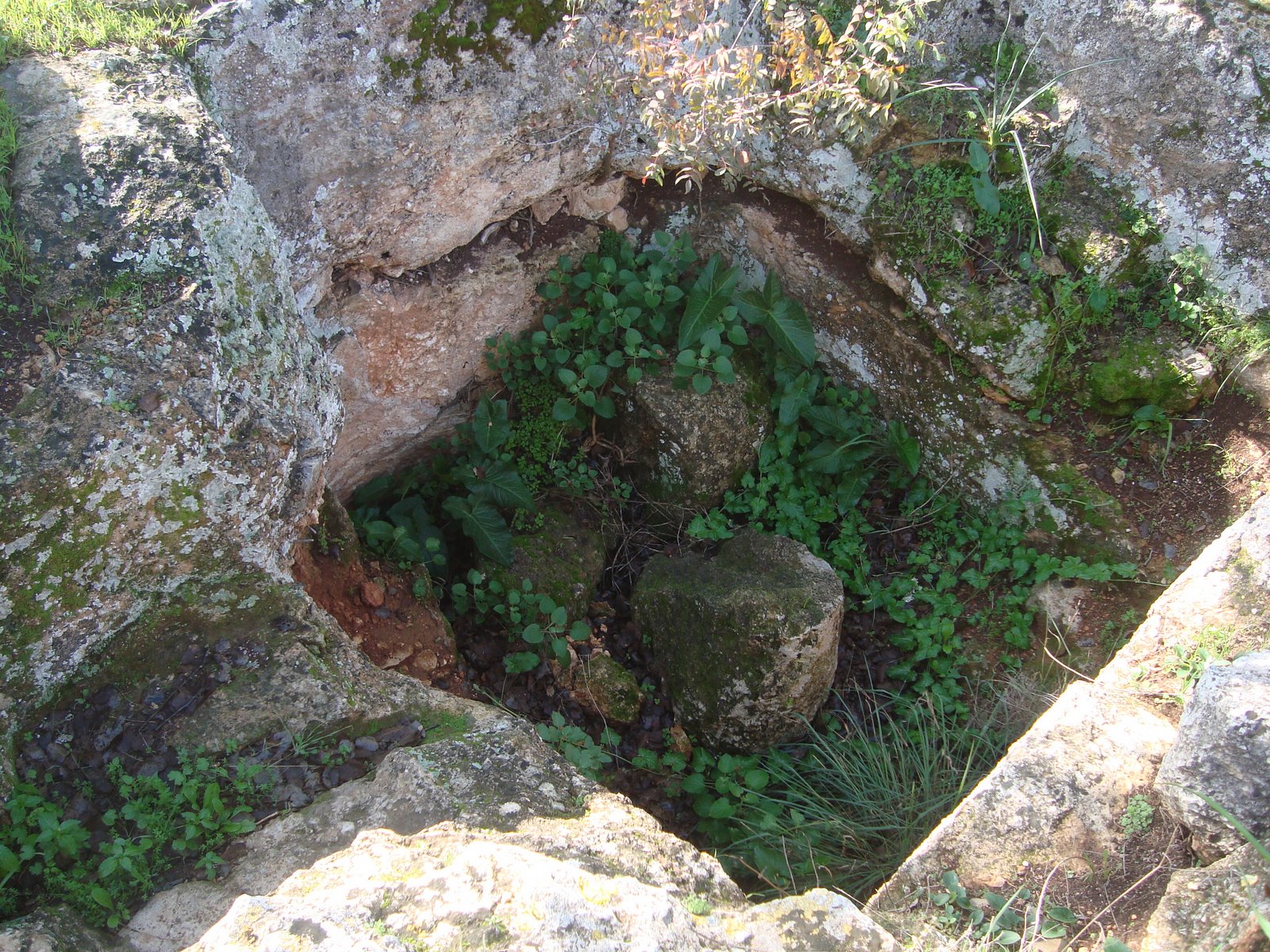
Today's route had us starting by descending a ravine that would lead us into the valley of the Yavniel stream. This un-named ravine wasn't exactly the Grand Canyon but if steep walls, rockhopping and descending cliffs comes to mind, then you're about right. Now that's all well and good for us oldies, but 9 year old legs are substantially shorter than our 50 year old ones and there were a couple of occasions when we had to lower Yael down a cliff face. This operation consisted of Garry being at the bottom, me holding her as I lowered her down to him and Yoni having a nervous breakdown, hoping that we wouldn't drop her or that Sigal wouldn't find out what he was doing with their youngest daughter. It was only after we got to a cliff that looked really impassable that we realised that we hadn't seen a trail marker for a while and perhaps there was an alternative route. Sure enough we found that the trail actually went above the ravine and the shvil painter wasn't about to try scaling cliffs, with or without 9 year olds in tow. The trail passed through the meadow above for a bit and rejoined the ravine when the escarpment was much less steep and descent was over rocks, not cliffs, easily managed on our bums
.
The marked path has crossed a few strange obstacles in the 140 or so kilometres that it's covered so far (Remember that the path had us walk through a closed military zone on our very first section) but this was the first time that we'd had to pass under an electrified wire in order to continue. Whether the sign on the wire was a bluff or not no-one was game to find out, but if the wire intended to keep cattle out of the area then I imagine that there may have been a few volts running through it. I imagine that you would need a lot of volts to keep cattle from crossing the wire .In any case cattle don't read so well and are not so bright as to contemplate the possibility that its a bluff.
Once we'd successfully ducked under the hotwire we quickly came out to a wide muddy path that ran adjacent to the Yavniel stream. The nachal is usually dry but was running very fast due to the rains. We found a nice spot not far from the water to sit and drink Garry's herbal tea, made all the more herbal by the wild mint that we picked along the way. After the break we continued down this path. It was a pleasant walk, the winter green now very deep. The wild flowers are starting to bloom already, so the green fields were sprinkled with yellows, whites and reds. Its not quite the high season yet but our next walks,
including nachal Amud next month, will have increasingly spectacular wildflower displays. The walking today was made more challenging by us having to look very carefully where to put our feet. The right hand side of the path was bordered by a single, familiar wire, one which we didn't want to touch under any circumstances. This proved to be quite a job at times since along the path there were numerous puddles of unknown depth or mud patches that would have made the most spoilt pig very happy . The left hand side was not always passable. We didn't see any spoilt happy pigs, nor did we see many cows, which usually pop up when walking through the countryside. We did see however two young bulls, their, ahem, bullness being obvious for all to see (When you got, flaunt it, I guess) The conversation between father and 9 year old daughter went something like this:
Yael: Daddy, what are those on the cows?
A pregnant pause. 9 year olds don't give up when you ignore their questions.
Yael (in a more insisting tone): Well Daddy, what are those on the cows?
Yoni: You know, Yael, beitsim. It's a bull, not a cow. (For those that don't speak Hebrew, beitsim literally means eggs but is the common word for testicles, much like "balls" is the common word in English)
Yael: Beitsim?
Yoni: yes, you know what they are.
Yael: (In a tone that is half knowing and half confused) Ah, like what we have for breakfast with our toast.
At this stage Yoni didn't feel the need to further Yael's education in the field of anatomy. Her time will surely come.
We came to a point where the road forked and it appeared that the right way was to go down the path that crossed the gushing stream. There were some rocks that we might have been able to use as stepping stones, but failure, which was a distinct possibility, would have had us swimming with the turtles that we'd seen here and there. So we decide to simply wade across the stream. The current was swift but not more than knee deep. We planned to either pass Yael from hand to hand across the stream, or one of us would piggy-back her. She was having none of this. She wasn't going to miss out on the fun of getting her feet wet. So there we were, playing adult and stupidly tip-toeing across the stream and trying not to get our feet wet, which was of course an impossibility in knee deep water and there was Yael, looking at the situation for what it was. Fun.

This path turned out to be the wrong path although not by a lot. After a few kilometres of us knowing only approximately but not exactly where we were, (not uncommon with us) it rejoined the marked shvil yisrael path.The only problem was that this path was sodden. We had to decide whether to walk through thick squishy mud, puddles whose depth we couldn't gauge or swamp. There was very little solid ground that was "safe" to walk on and zero dry ground. Certainly there was no "right" way through. So what would probably have taken us an hour or so under normal conditions took us well over two hours. There's no way of knowing if the alternative marked path would have been any better but an uneducated guess would have me believe that it wouldn't have been. This continued on for a few kilometres and by the time we got to Sigal's car we were covered from head to toe in thick gooey mud. This is not a printing mistake. Yoni donated his car to his oldest daughter Lior for the day, so he was driving Sigal's car. Fine. Maybe. Garry and I have known Sigal almost as long as Yoni has known her, and the three, no, four of us knew that returning Sigal's car to her with even a little bit of mud in it would not be greeted with widespread approval. I think the word "divorce" was uttered under breath. Luckily, or cleverly, Yoni (or Sigal) had large garbage bags in the boot of the car. Yoni took his shoes off and threw them into a bag and into the boot, and drove the car in wet socks. We wrapped our legs into the bags, pulled them up as high as we could and sat in the car like cocoons. I have a feeling that Yoni and Yael went home via the carwash.
When we'd finished a previous leg (7th day) at more or less the same finishing point we'd eaten lunch at the Uggata coffee shop, which was ok. We wanted to broa den our culinary horizons so were recommended a place at kibbutz Degania bet. Firstly we were too embarrassed by our filth to even try to go into the coffee shop. Hunger overcame embarrassment but the place turned out to be a chocolattier which made fine hand made chocolate but didn't serve food. Perhaps Yoni should have bought Sigal some fine hand-made chocolate to soften the dirt of the car. Anyway we got to Tzemach junction and found a generic middle eastern meat-on-the-grill restaurant which usually have poor hummus, soggy chips and expensive tourist prices. To our surprise the place had good hummus, crisp chips and expensive tourist prices.


Sunday, 27 December 2009

11th day (A Stroll In The Woods)

Merry x-mas.
It's a sign that we're moving forward when the Seggafreddo at Kedarim is not a stopping point on the way to the start of a leg. Today we met in a different petrol station in a different area. We didn't even check if we could get coffee there. We didn't know it then but we really didn't need to hurry.
There was some doubt whether we were going get to walk today as Garry was carrying a basketball injury from earlier in the week. He actually tripped over the basketball and fell onto it, hurting his ribs. Bet Michael Jordan never managed that! So as long as he didn't laugh, sneeze or jump then he'd be ok. Sneezing we can't control, it was an easy walk that didn't demand any commando style jumping, but we usually do have a good laugh.
From Tzomet Hamovil (Hamovil Jct.) we drove on to the village of Mash'had and met up with Tracey who decided that she could put up with us once more, or maybe we'd decided that we could put up with her once more . Perhaps she just couldn't resist the animal magnetism of 3 middle aged men in various stages of over-weightness and baldness, or simply she was just so bored that even a day with us looks like a good time. At any rate, it was nice to have her along again.
Since we all live in the Galil and going through an Arab village is about as interesting and exciting as watching grass grow, we decided to drive through Mash'had and start walking when the village gives way to forest. Having said that, Mash'had is much cleaner and well kept than the run down villages in our immediate vicinity, but as Yoni pointed out, that really isn't very hard. I was of the opinion that the village was still part of the shvil so we could have walked at least through part of it but I was outvoted 3 to 1.
So once again we parked the car in an ad hoc garbage dump that seems to be at the edge of every Arab village, rolled our eyes, clicked our tongues , crinkled our noses at this offence to our western sensibility, and set off. The village ended in a very pretty pine forest that unfortunately wasn't spared the cultural view that garbage can be dumped anywhere that isn't in my house, but after a few minutes it was just us and nature.
This pine forest  descended into a small valley that we would walk through for the next while. Very pastoral. A lush green valley surrounded by forest, the houses of the community settlement of Hoshi'a on one side of the valley and at the mouth of the valley some distant hills. It goes without saying that there were, of course, cows feeding in this meadow. We passed the back gate of Hoshi'a, turned left and walked towards the settlement of Tzippori. Modern day Tzippori sits adjacent to the ruins of the ancient city of Tzippori, seat of the Sanhedrin. This site is so important to the history of the Jewish people in Israel that the education ministry dictates that every Jewish school pupil must visit the site at some point in his schooling.  Since we finished school a few years ago already and the path doesn't actually go through the historical site and I think we have all been at some point to the very impressive ruins, we didn't go in. The shvil did however go past the grave of the Rabbi Yehuda HaNassi, one of the more important figures of that period.
We'd been walking for all of an hour and a bit when we felt that our sandwiches were weighing our bags down so we stopped to have some of Garry's herbal tea, croissants and sandwiches. Ahh, it's a hard life, but someone's gotta do it. Now that we were rested and the food was weighing our stomachs rather than our bags down we re-started up a hill. A hill, not a mountain like the previous walk. A bit steep, but even Yoni and his new-found whinging partner didn't complain too much. If truth be said, I think Yoni led the charge up the hill. A first time for everything.
And so we ambled on. When we weren't walking through forest we walked through open meadows, the grass wet with morning dew, which in turn soaked our feet but left the rest dry. It appears that we weren't the first ones to notice that this leg is a very relaxed one, after the Swiss Alps that we negotiated last time. Even the shvil maker had his shabbat day off today. There were places where the way was so obvious that they didn't really make a path to follow. Sort of "get to the other end of the field and you'll know where to go". A marking here and there. In the beginning of the walk the shvil marker must have left his blue paint at home because we had white and orange markings without the blue. This continued on while the shvil marker's assistant ran home to find the blue paint he'd forgotten under his bed. Eventually he got back with the blue paint, but in keeping with today's easy going attitude, he didn't go back and repaint the bits that were just orange and white. If the shvil painter and his assistant had been Australian they probably would have said something like "no worries, mate".
The forest changed from K.K.L planted pine forests to natural oak. Actually there's a plague that's killing off the conifers in the Middle East. It started in Turkey and has spread through Lebanon and is making its way south through Israel. It was quite evident today. Patches of pines and cedars that were dead or dying. For Israel it's not actually such a bad thing. The J.N.F planted lots of these trees in the past because they're hardy and quick growing but they prevent the regrowth of the natural oak. If the planted pines die off this will allow the natural forest to grow back.
So after a little more than 2 hours of easy relaxed walking on a superb sunny winter's day, through green valleys, open meadows and forests, we found the petrol station where the car was parked. We decide to leave the marked shvil path and make our way directly to the petrol station. This was all fine and good but it meant us having to negotiate a couple of barbed wire fences. Remember, Yoni and barbed wire don't go together, or more correctly, go together too much. Finally, after all these years of walking, Yoni seems to be getting the hang of getting through barbed wire unscathed.
The only question left to answer was would El-tanur be open this early? Remember last time this gourmet Arab restaurant  was closed for the Muslim holiday of Id-el-Atchah. On the Christian holiday of Christmas there was no such problem. The salads, local wild greens, and most importantly stuffed lamb shoulder was there waiting for us when we got there.
P.S. A word about the book. Over the course of these past 10 months there have been a few times when I've doubted the authenticity or reliability of the book. Today just takes the cake. Today's leg is stated as 13 km. We drove about 2 km through Mash'had, leaving 11 km of walking. We tend to walk quite quickly but not so quickly that we can cover 11 km in 2 1/2 hours. The last leg was rated as of medium difficulty, including the first part straight up Mt. Tabor which we didn't do. Perhaps if you're a 21 year old who just finished the army then it may be a medium difficulty walk. But here's the rub. Today's walk was also rated as medium difficulty. My 91 year old grandmother wouldn't have found this a medium difficulty walk, barring perhaps the one hill that Yoni ran up. This leads me to the conclusion that the author of the book wrote it from the comfort of his study, aided by an old 1:50,000 contour and path map and skilled use of Google Earth.
 
 
Outdoors Blogs
Outdoors blogs